In this guide
San Diego water restrictions work in two layers. In the City of San Diego, a short list of permanent rules applies every day, even in a wet year: no water running off your yard onto the sidewalk or street, a shut-off nozzle on any hose you use to wash a car, leaks fixed fast, and a few rules for restaurants and hotels. On top of that sit shortage levels. Your water agency only switches those on when supplies get tight, and each level brings tighter limits on landscape watering and other outdoor use.
The quickest way to know where you stand is to find the name of your water agency on your bill, then check that agency's website for its current shortage level. The rest of this guide explains who sets the rules, what the permanent ones say, and what changes when a level is declared. For more guides on day-to-day life here, browse the Living in San Diego section.
Who sets the rules
People often assume there's one countywide rulebook. There isn't. Water rules come from three places, and the one that matters most for your sprinklers is the closest one.
The state
California sets the big-picture targets. The State Water Resources Control Board's regulation known as "Making Conservation a California Way of Life" took effect on January 1, 2025. It gives each urban water supplier a water-use objective to meet. It doesn't tell you which day to water. It pushes your supplier to manage demand, and your supplier turns that into local rules.
The San Diego County Water Authority
The San Diego County Water Authority is the regional wholesaler. It buys and produces water and sells it to the cities and water districts that serve homes and businesses. Its Water Shortage Contingency Plan has six levels, matching the six-level structure in the California Water Code. Level 1 is voluntary conservation. The Water Authority activated Level 1 in October 2021 and asked residents to cut use by 10%. Earlier versions of the plan were activated in 2007 and 2014.
Your local water agency
The agency on your bill is the one that adopts and enforces rules for your property. That might be the City of San Diego, a city like Oceanside or Escondido, or a water district such as Helix, Otay, Olivenhain or Sweetwater. Each has its own ordinance. They tend to follow the Water Authority's levels, but the exact wording, watering days and enforcement can differ. Two neighbors on either side of a district line can have slightly different rules.
| Layer | Who | What it controls |
|---|---|---|
| State | State Water Resources Control Board | Targets for water suppliers; statewide laws such as AB 1572 on decorative turf |
| Region | San Diego County Water Authority | Wholesale supply and the regional shortage plan |
| Local | Your city or water district | The rules for your address, watering days, enforcement |
| Your home | You | Fixing leaks, setting the irrigation timer, avoiding runoff |
Rules that apply every day in the City of San Diego
If the City of San Diego is your water provider, its Water Use Restrictions page lists permanent, mandatory rules that stay in force all year. The main ones:
- Irrigation water can't flow onto sidewalks, driveways, streets, gutters or a neighbor's property.
- A hose used to wash a vehicle must have a nozzle that stops the flow when you let go.
- Hosing down sidewalks, driveways and parking areas is limited; the City's rules call for a power washer or a hose with a shut-off nozzle.
- Ornamental and cascading fountains can't run on non-recirculating drinking water.
- Restaurants and bars serve drinking water only when a customer asks for it.
- Hotel and motel guests must be offered the option of not having towels and linens washed daily.
- Leaks have to be repaired when you find them, or within 72 hours of being notified by the City.
None of this is new or dramatic. Most people already follow these rules without thinking about it. The one people miss most is runoff, which gets its own section below.
What changes when a shortage level is declared
When supplies drop, an agency can declare a shortage level and the rules tighten step by step. Over the years, San Diego agencies have used limits such as a set number of watering days per week, shorter watering times, and bans on watering during or right after rain. In June 2022, for example, the City of San Diego moved to Level 2 and, among other measures, banned irrigation during and within 48 hours of a rain event.
The City rewrote this part of its Municipal Code in 2026. Ordinance O-22105 amended the emergency water regulations in Chapter 6, Article 7, Division 38, effective July 15, 2026. It renames the old "Drought Response Levels" as "Water Shortage Levels," ties them to the City's 2025 Water Shortage Contingency Plan (adopted by the City Council in May 2026), and folds in the newer state requirements. If you remember the old drought-level charts from a decade ago, they're out of date. Look up the current plan instead of relying on memory.
Two practical points:
- A declared level is announced. Agencies post it on their websites and usually send notices with bills. If you haven't heard anything, check rather than assume.
- Levels can be lifted. The 2014–2017 drought ended with the state lifting emergency restrictions in 2017. When a level ends, you're back to the permanent rules, not to "anything goes."
Lawns, turf and AB 1572
A state law signed in October 2023, Assembly Bill 1572, is phasing out the use of drinking water on "nonfunctional turf." That means decorative grass nobody uses for recreation or gatherings: the strip along a parking lot, grass in a street median, the lawn in front of an office building. The State Water Resources Control Board's nonfunctional turf page explains the scope.
The law applies to commercial, industrial and institutional properties, public properties and the common areas of multifamily buildings and HOAs. It does not cover the lawn in front of a single-family home. It also doesn't stop irrigation with recycled water, or watering trees and other plants that aren't turf. The deadlines are staggered by property type, starting with properties owned by public agencies. If you sit on an HOA board or manage a building, ask your water agency which date applies to you, because the City's 2026 ordinance writes these requirements into local code.
Runoff: the rule people break without noticing
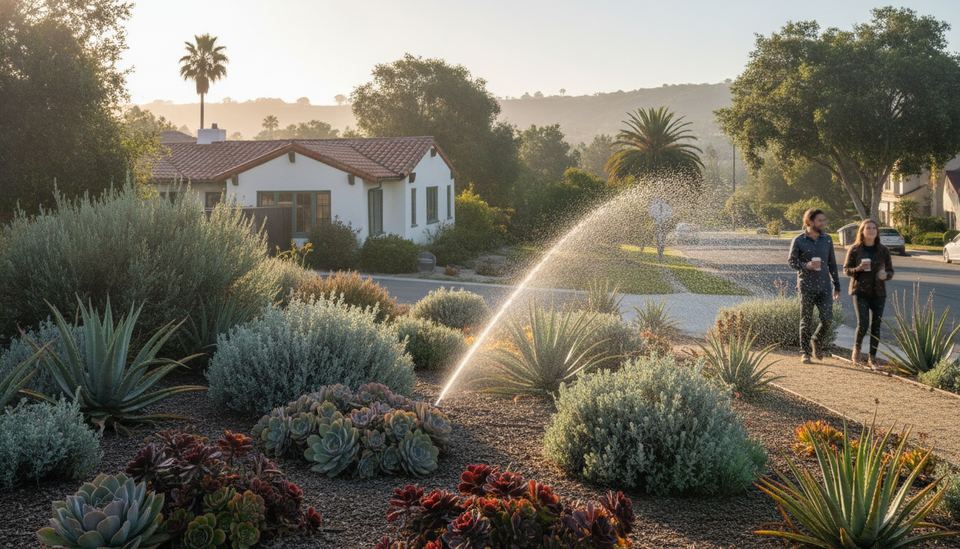
Runoff is the permanent rule most households break, usually by accident. A sprinkler head knocked sideways, a timer set for too many minutes on a slope, a zone that kicks on during a storm. Water hits the sidewalk, runs into the gutter and keeps going.
That water doesn't go to a treatment plant. Storm drains in San Diego carry it, along with fertilizer, pet waste and whatever else it picks up, to creeks, the bays and the ocean. That's why the City treats runoff as a stormwater problem under its Municipal Code (Section 43.0304) as well as a water-waste problem. If you care about clean water at the beach (see our guide to picking a San Diego beach), this is one rule that does more than save a few gallons.
A few habits that help:
- Walk your yard while each sprinkler zone runs. You'll spot broken heads and overspray in a couple of minutes.
- On slopes and clay soil, split one long watering into two or three shorter cycles so water soaks in.
- Turn the controller off when rain is forecast, even when no shortage level is active.
- Point downspouts at planted areas instead of the driveway.
Older homes, older plumbing
Neighborhoods with older housing stock, like North Park, have plenty of original plumbing and decades-old irrigation. That's where slow leaks hide: a running toilet, a dripping hose bib, a cracked line under a lawn that stays green when everything around it is brown. The City's leak rule gives you 72 hours after notice, but a leak costs you money long before that. Check your meter with every tap off. If the leak indicator keeps moving, you have a leak somewhere.
Rebates and free help
You don't have to figure this out alone. The Water Authority's WaterSmart San Diego site lists rebates and free landscape classes, sorted by water agency. City of San Diego customers have had rebates for items like rain barrels and downspout redirects. Residents of unincorporated areas can look at the County of San Diego's Waterscape Rebate program for replacing turf with low-water plants. Amounts and eligibility change, so read the current terms before you buy anything.
Here's my own approach as someone who walks a lot of San Diego blocks: the permanent rules are easy, the shortage levels are what catch people out, and the fix is one bookmarked page from your own water agency. For more practical guides, the full list of our articles is a good place to browse.
Your checklist
Your San Diego water-rules check
Tick each step as you go. Your progress stays in this browser.
- Your local water agency
- What changes when a shortage level is declared
- Rules that apply every day in the City of San Diego
- Runoff: the rule people break without noticing
- Runoff: the rule people break without noticing
- Older homes, older plumbing
- Lawns, turf and AB 1572
- Rebates and free help
Next up: Runoff ends up at the coast. See how to pick the right San Diego beach for your day.
Questions readers ask
Are there water restrictions in San Diego right now?
A set of permanent water-waste rules applies all year in the City of San Diego, whatever the weather. Stricter limits, such as fewer watering days, only apply once a shortage level is declared. Your water agency's website shows the current level.
Can I wash my car at home in San Diego?
Yes, as long as the hose has a shut-off nozzle that stops the water when you let go. This is one of the City's permanent rules.
Who sets water rules in San Diego County?
Three layers: the state sets targets for water suppliers, the San Diego County Water Authority manages regional supply and its own shortage plan, and your local water agency adopts and enforces the rules for your address.
Does the turf law mean I have to remove my front lawn?
No. AB 1572 covers decorative grass on commercial, industrial, institutional and public properties and multifamily common areas. It does not cover single-family yards.