In this guide
Yes, San Diego gets earthquakes, and the city sits right on top of an active fault. The Rose Canyon fault runs from offshore near La Jolla through the Old Town and downtown area and into San Diego Bay. Bigger, faster-moving fault systems lie farther inland, and you'll occasionally feel shaking from quakes in Baja California or the Imperial Valley. Most days you won't notice anything, but the risk of a damaging quake is real enough that every household here should have a plan.
The good news is that preparing doesn't take much: a few free apps, one practiced move, a strapped water heater and some stored water cover most of it. This guide explains the faults first, then the steps.
The faults that matter for San Diego
Rose Canyon fault: the one under the city
The California Geological Survey describes the Rose Canyon fault zone coming ashore east of La Jolla Cove as a band of faults up to about 1 mile (1.5 km) wide. From there it runs south through the Rose Canyon area, past Old Town, under downtown, and then steps offshore into San Diego Bay. Researchers at San Diego State University have mapped how it splays near the bay, including a segment that runs under the airport area.
How big could a Rose Canyon earthquake be? Studies give a range rather than one number. A 2017 study led by Scripps Institution of Oceanography at UC San Diego, with USGS co-authors, found that the linked Newport-Inglewood/Rose Canyon system along the coast could produce up to a magnitude 7.3 if its offshore segments ruptured together, and 7.4 if the southern onshore segment joined in. The Earthquake Engineering Research Institute's San Diego chapter built its damage scenario around a magnitude 6.9 on the Rose Canyon fault.
Big quakes on this fault are rare compared with a human lifetime. That's part of the problem: it's easy to forget about it.
Inland faults: Elsinore, San Jacinto and beyond
East of the coast, the Elsinore fault zone cuts through the backcountry, and the San Jacinto fault zone lies farther east. The City of San Diego's Seismic Safety Element notes that the Elsinore zone is the closest of these major active inland faults to the city, and that a large Elsinore quake would hit northeastern parts of the region harder than the urban core. The San Andreas fault is farther away still, out near the Salton Sea, but a very large rupture there could still be felt here.
For a regional picture of recent activity, the USGS earthquake map shows quakes in real time, including the small ones you never feel.
What shaking means for San Diego homes
How much damage a quake causes depends on distance, depth, soil and the building. A few local patterns are worth knowing:
- Soft, filled ground near the bay and in river valleys can shake harder than rock and, in some spots, is prone to liquefaction.
- Older unreinforced masonry and some older wood-frame homes with weak connections to their foundations are more vulnerable than modern construction.
- Inside a home, most injuries come from things falling: shelves, TVs, mirrors, heavy frames, kitchen cabinets.
That last point is the one you can fix this weekend. If you rent, talk to your landlord before drilling into walls.
Earthquake early warning: what the apps can do
California has a public earthquake early-warning system built on the USGS ShakeAlert network. It can't predict quakes. It detects one that has already started and sends an alert that can arrive a few seconds before strong shaking reaches you, which is enough time to drop and cover.
| Tool | Who runs it | What it does |
|---|---|---|
| MyShake app | California Governor's Office of Emergency Services (Cal OES) | Free phone alerts statewide, based on ShakeAlert |
| SD Emergency app (ShakeReadySD) | County of San Diego | Free alerts based on ShakeAlert, plus local emergency info; the County says alerts go out for quakes of magnitude 4.5 and above |
| Wireless Emergency Alerts | Sent to compatible phones | Text-style alerts for stronger quakes, no app needed |
| AlertSanDiego | County of San Diego | Register a phone or email for local emergency notifications |
The County of San Diego notes on ReadySanDiego.org that alert delivery can depend on your carrier and signal, so don't count on the warning. Count on knowing what to do without it.
Getting your home ready
Secure the heavy stuff
Start with the rooms where you sleep and sit the most. Anchor tall bookcases and dressers to wall studs, strap down TVs, move heavy items to low shelves, and use latches on kitchen cabinets that hold dishes or glass. Keep heavy framed art away from beds.
Strap the water heater
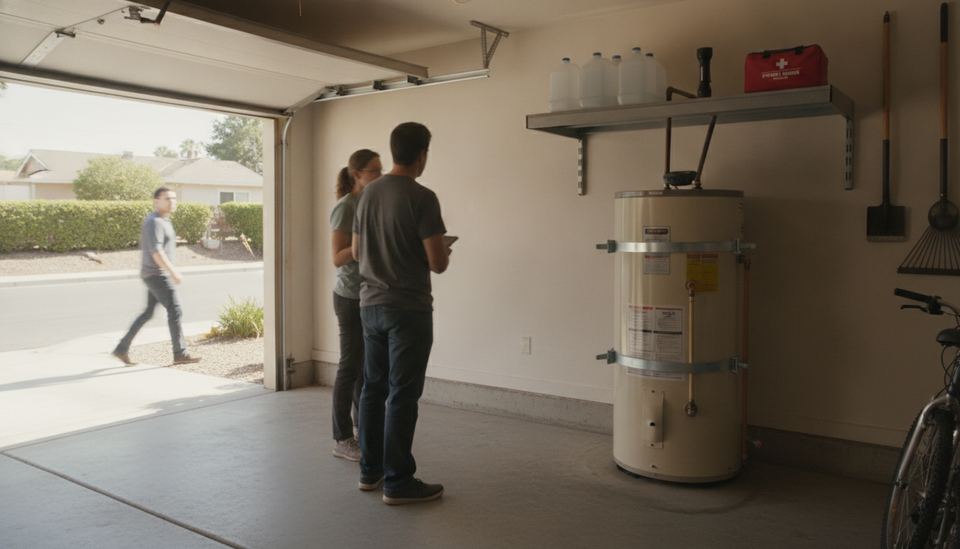
This one is required. California Health and Safety Code section 19211 says residential water heaters must be braced, anchored or strapped to resist falling or moving sideways in an earthquake. A tipped water heater can break gas and water lines. If you rent, it's the owner's job, but you can check that it's done. A licensed plumber can install or inspect the straps.
Know your shutoffs
Find your gas meter and main water shutoff before you need them. Only turn off the gas if you smell gas, hear a hiss or suspect a leak; once it's off, the utility has to restore it. Your gas utility's website explains the shutoff for your meter.
Store water and supplies
Ready.gov recommends storing at least one gallon (about 3.8 liters) of water per person per day for several days. Much of the region's water travels long distances through pipelines and aqueducts, so plan as if the tap might not work for a while after a big quake. Add a few days of food that doesn't need cooking, a flashlight, batteries, a first-aid kit, prescriptions, copies of key documents, and pet supplies.
Many of the same supplies serve for fire season. Our guide to the Santa Ana winds covers the go-bag side for wildfire weather.
Insurance and costs: what to look into
Standard homeowners and renters policies in California generally don't cover earthquake damage. Coverage is sold as a separate policy, through the California Earthquake Authority (via participating insurers) and some private companies. Deductibles are often a percentage of the coverage amount rather than a flat figure, which matters a lot for your budget. This is a decision to make with a licensed insurance agent, and it belongs on the list when you work out the cost of living in San Diego.
Homeowners with older houses can also look into seismic retrofits, such as bolting the house to its foundation and bracing short cripple walls. A licensed contractor or structural engineer can tell you whether your house needs it.
After the shaking stops
- Check yourself and others for injuries.
- Expect aftershocks. Drop, cover and hold on again if they come.
- Look for gas leaks, fires and damaged wiring. Get out if the building looks unsafe.
- Text rather than call, to keep phone lines open for emergencies.
- Follow official updates from the County of San Diego and your city.
- If you're near the coast and the shaking was strong or long, move inland or to higher ground and follow official tsunami guidance.
Practice once a year
The Great California ShakeOut drill happens every October. In 2026 it was held on October 15. It's a good annual reminder to practice Drop, Cover and Hold On with your household, check your supplies and swap out old water. For more on everyday life here, from utilities to weather, see the rest of our Living in San Diego section.
Your checklist
Your San Diego earthquake prep checklist
- Earthquake early warning: what the apps can do
- Earthquake early warning: what the apps can do
- Practice once a year
- Secure the heavy stuff
- Strap the water heater
- Know your shutoffs
- Store water and supplies
- Store water and supplies
- Insurance and costs: what to look into
Next up: Know your ways around town too: here's how to ride the COASTER from Oceanside to downtown.
Questions readers ask
Does San Diego have a fault running through it?
Yes. The Rose Canyon fault comes ashore near La Jolla and runs through the Old Town and downtown area before curving into San Diego Bay, according to the California Geological Survey.
How big an earthquake could hit San Diego?
Estimates vary by study. A 2017 Scripps Institution of Oceanography study with USGS co-authors found the Newport-Inglewood/Rose Canyon system could produce up to a magnitude 7.3, or 7.4 if the southern onshore segment also ruptured.
Is there an earthquake warning app for San Diego?
Yes. Cal OES offers the free MyShake app, and the County of San Diego's free SD Emergency app includes ShakeReadySD, both based on the USGS ShakeAlert system. The County says alerts go out for quakes of magnitude 4.5 and above.
What should I do during an earthquake?
Drop to your hands and knees, take cover under a sturdy table or desk (or cover your head and neck next to an interior wall), and hold on until the shaking stops.
Does homeowners insurance cover earthquakes in California?
Standard homeowners and renters policies generally exclude earthquake damage. Earthquake coverage is a separate policy, offered through the California Earthquake Authority and some private insurers. Ask a licensed agent about your situation.